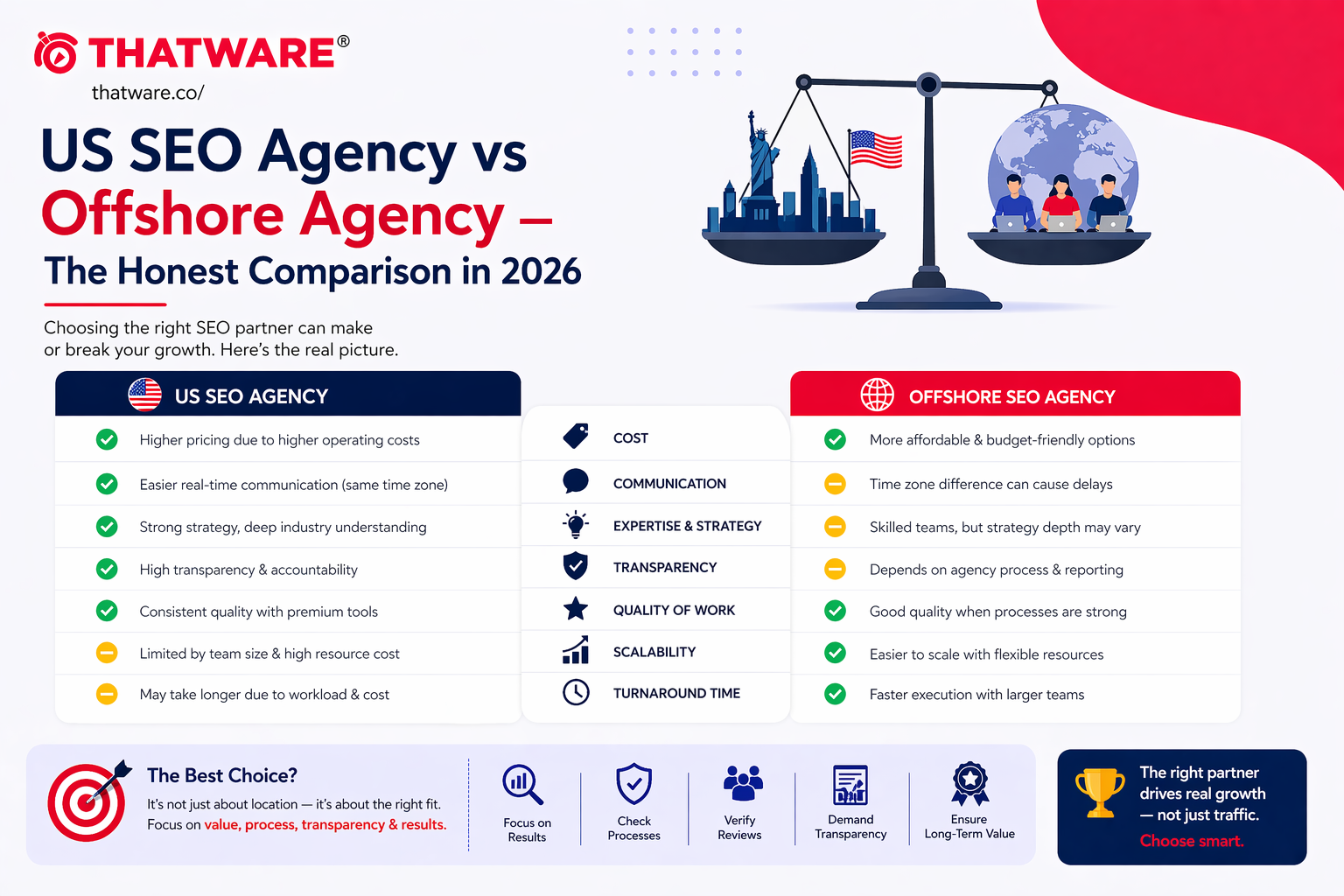
This debate has been going on for years, and honestly, the framing hasn’t aged that well. “US agency vs. offshore agency” implies a binary that doesn’t really reflect how the industry works anymore. Some of the most capable SEO talent in the world is in India, Southeast Asia, Eastern Europe, and Latin America. Some of the most overpriced and underdelivering agencies are in New York and San Francisco.
What actually matters isn’t geography. It’s capability, communication, and accountability. But those things do have some correlation with geography – just not the simple correlation that the “buy local” crowd usually implies.
Here’s a more honest breakdown of what you’re actually choosing between.
What You’re Paying For With a US Agency
US-based SEO agencies are typically more expensive, sometimes significantly. In 2026, a mid-tier US agency running a comprehensive SEO retainer for a competitive market is commonly in the range of $5,000–$15,000+ per month depending on scope. That pricing reflects a few things.
Overhead is real. US labor costs, office space in major markets, benefits, and general business costs in the US are genuinely higher than in most offshore markets. Some of that cost goes to actual capability – talented US-based strategists and writers often command it. Some of it is just the cost of being headquartered in an expensive market.
There’s also a cultural and market knowledge premium that’s sometimes worth paying for. An agency with a team that grew up using US search, understands US consumer language and behavior, and has long-standing relationships with US-market publications has real advantages for brands trying to reach US audiences. That’s not nationalism – it’s just context.
The accountability question is also different in a domestic engagement. US legal frameworks, clearer contract enforcement, and easier escalation paths if things go wrong are legitimate considerations for larger engagements where the stakes are high.
What Offshore Actually Looks Like in 2026
The offshore market has changed a lot. The stereotype of low-cost, low-quality SEO churn farms still exists – there are absolutely agencies in India, the Philippines, and elsewhere that fit that description. But there are also offshore agencies with world-class technical depth, sophisticated content strategies, and track records in competitive international markets that rival anything produced by domestic US agencies.
The talent pipeline in India specifically has matured considerably. There are SEOs who have been working in the field for 15+ years, who have deep algorithmic knowledge, who have navigated multiple major updates, and who produce genuinely excellent work. They’re often priced at a fraction of their US equivalent – not because the quality is lower, but because the cost of living and business overhead in their markets are lower.
Seo agency usa rates might include US-timezone availability and seamless communication as part of the value proposition – and those things are genuinely valuable. But if an offshore agency offers responsive communication, strong English, and demonstrated US-market results, the timezone argument becomes much weaker.
Where the Real Risks Are
If you’re considering an offshore engagement, the risks worth taking seriously are fairly specific.
Content quality for English-language markets. This is the most common failure mode. Content produced offshore for English-speaking audiences is sometimes technically competent but feels slightly off – phrasing that’s grammatically correct but doesn’t quite match how native speakers write. For content targeting US, UK, or Australian audiences, that “off” quality registers negatively with readers and increasingly with AI content systems that are trained on native-speaker text. This isn’t an insurmountable problem – many offshore agencies have native or near-native English writers, or use US/UK editorial oversight – but it’s worth specifically evaluating.
Communication latency and accountability. Not all offshore agencies are equally responsive or equally accountable when things go wrong. The better ones treat responsiveness as a core part of their offering. The worse ones go quiet when results underperform. Getting a clear picture of communication practices – and actually testing them during the evaluation process – is worth doing.
Long-term relationship investment. Some offshore agencies treat client relationships transactionally in a way that limits strategic depth. The best partnerships – regardless of geography – involve agencies that genuinely understand your business and invest in that understanding over time. It’s worth evaluating whether an offshore agency is set up for that kind of relationship.
The Hybrid Model Worth Considering
An increasingly common and often effective approach is a hybrid model: US-based strategy and account management combined with offshore execution. You get the market knowledge, communication, and accountability of a domestic lead with the cost efficiency and technical depth of an offshore team.
Not every engagement is set up for this, but it’s worth asking about when you’re evaluating agencies. Some american seo firm options are already operating this way – they just don’t always advertise it prominently. And some offshore agencies have built US-facing teams specifically to bridge this gap.
The Questions That Actually Matter
Geography aside, the questions that should drive your decision are consistent regardless of where an agency is based.
Can they demonstrate specific results in your market and competitive context? Not generic case studies – relevant ones with numbers you can probe.
Do they understand the current SEO landscape, including AI search, E-E-A-T, and how the industry is evolving? Agencies still operating on 2019 playbooks – domestic or offshore – are a liability.
Is communication consistently responsive and substantive? Test this during the pitch process. Agencies that are slow or vague during sales are rarely faster or clearer after you’ve signed.
Do they have a coherent point of view on strategy, or are they just executing a menu of services? The best agencies – wherever they’re based – think strategically about your specific situation rather than applying the same approach to every client.
The geography question is real, but it’s secondary to these fundamentals. Get those right, and you’ll find the right partner regardless of which side of the ocean they’re on.